
Net Metering New Policy
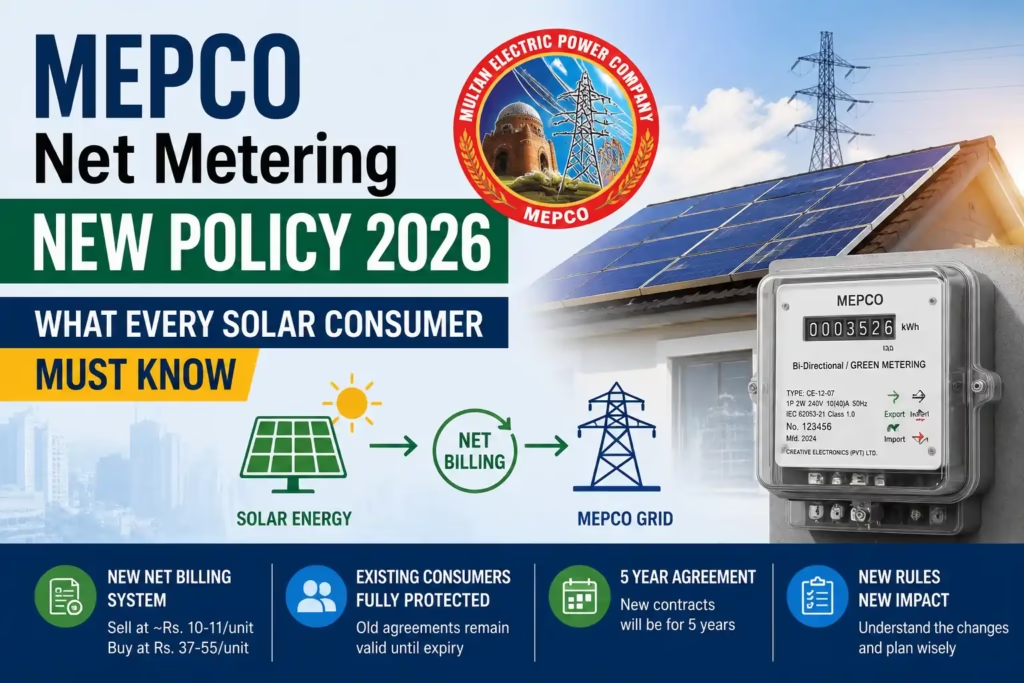
MEPCO Net Metering New Policy 2026 – What Every Solar Consumer Must Know
If you have a solar system installed at your home, shop, or factory in any MEPCO area — or if you are planning to install one — then the new net metering policy announced in February 2026 is the most important update you need to understand right now. This new policy has completely changed the way surplus solar electricity is bought and sold in Pakistan.
On 9 February 2026, NEPRA (National Electric Power Regulatory Authority) officially notified the NEPRA Prosumer Regulations 2026, replacing the old Net Metering Regulations 2015 that had been in place for over a decade. This policy change affects thousands of solar users across Pakistan, including many consumers in the MEPCO region. Whether you already have a net metering connection or are planning a new solar installation, understanding these new rules is important before making any investment decision.
This guide explains the MEPCO Net Metering New Policy 2026 in simple language so consumers can understand how the new rules may affect their solar investment and future electricity bills. The MEPCO Net Metering New Policy 2026 introduces major changes for both existing and new solar consumers.
What Was the Old Net Metering Policy? (2015–2026)
Under the old NEPRA Net Metering Regulations 2015, the system worked on a simple unit-for-unit basis. If you exported 1 unit of solar electricity to the MEPCO grid, you got 1 unit back from the grid for free. This meant:
This system encouraged massive solar adoption across Pakistan. Rooftop solar capacity grew to over 6,000 megawatts nationally. However, NEPRA argued that this rapid growth was creating financial losses for electricity distribution companies (DISCOs) like MEPCO and causing grid instability issues during peak solar generation hours.
The MEPCO Net Metering New Policy 2026 was introduced to replace the older net metering framework that remained in place for more than a decade.
MEPCO Net Metering New Policy 2026 – NEPRA Prosumer Regulations
The new policy replaces unit-for-unit net metering with a system called Net Billing. Under net billing, the buying and selling of electricity happens at two completely different rates:
This means you no longer get a unit-for-unit exchange. You sell cheap and buy expensive. The difference between what you sell and what you buy is what you pay MEPCO every month.
For the latest regulations, notifications, and official updates, consumers can visit the Nepra Official Site.
Simple Example to Understand Net Billing:
| Item | Old Net Metering (2015) | New Net Billing (2026) |
|---|---|---|
| Units exported to grid | 200 units | 200 units |
| Export / Buyback rate | Rs. 26/unit (same as import) | Rs. 11/unit (NAEPP) |
| Credit earned from export | Rs. 5,200 | Rs. 2,200 |
| Units imported from grid | 200 units | 200 units |
| Import rate (consumer tariff) | Rs. 26/unit | Rs. 45/unit (example) |
| Amount to pay to MEPCO | Rs. 0 (fully offset) | Rs. 6,800 (after deducting export credit) |
This example shows how the new net billing system results in significantly higher monthly bills compared to the old one-to-one net metering system.
Key Changes in MEPCO Net Metering New Policy 2026
Here is a complete summary of all the major changes in the new policy:
| Feature | Old Policy (2015) | New Policy (2026) |
|---|---|---|
| System Name | Net Metering | Net Billing (Prosumer Regulations) |
| Billing Method | Unit-for-unit exchange | Separate buy and sell rates |
| Export / Buyback Rate | Rs. 25–26 per unit | ~Rs. 10–11 per unit (NAEPP) |
| Import Rate | Same as export rate | Regular consumer tariff (Rs. 37–55/unit) |
| Contract Duration | 7 years | 5 years |
| Capacity Limit | Up to 1 MW | Up to 1 MW (same) |
| Eligible Systems | Solar only | Solar, Wind, Biogas (all clean energy) |
| Effective Date | 2015 | 9 February 2026 |
| NEPRA rate revision power | Limited | NEPRA can revise buyback rate during contract |
| Capacity payments burden | On all consumers (indirect) | Shifted more toward solar consumers |
Are Existing MEPCO Solar Consumers Affected?
One of the biggest concerns about the MEPCO Net Metering New Policy 2026 is how it affects existing net metering agreements. This is one of the most common questions asked by solar consumers. The answer depends on when you got your connection approved.
If You Had a Valid Net Metering Agreement Before 9 February 2026:
You are fully protected. NEPRA issued an amendment on 16 February 2026 (after direct intervention by Prime Minister Shehbaz Sharif) confirming that:
If You Had a Pending Application Before 8 February 2026:
Power Minister Awais Leghari confirmed that 5,165 applications submitted before 8 February 2026 for a total of 250.822 MW of capacity will be processed under the old net metering policy. If your application was pending before this date, you may still qualify for the old rates.
If You Are Applying After 9 February 2026:
All new applications submitted after 9 February 2026 are fully governed by the new NEPRA Prosumer Regulations 2026. This means:
Why Did NEPRA Make This Change?
According to NEPRA, several factors influenced the decision to replace the old net metering framework with the new prosumer regulations.
Understanding the MEPCO Net Metering New Policy 2026 is important before submitting a new prosumer application.
How to Apply for Net Metering (Prosumer) Under the New Policy – MEPCO
If you are a new applicant and want to connect your solar system to the MEPCO grid under the new Prosumer Regulations 2026, here is the step-by-step process:
Step 1 – Make Sure You Meet the Requirements
Before applying, confirm that your setup meets the following conditions:
Step 2 – Prepare Required Documents
Step 3 – Submit Application to MEPCO
Submit your complete application to your nearest MEPCO subdivision office or XEN (Executive Engineer) office. Make sure to get an acknowledgement slip with date and application reference.
Step 4 – Technical Inspection
MEPCO will assign a technical team to inspect your solar installation. They will verify that:
Step 5 – Meter Replacement and Agreement Signing
After inspection, MEPCO will install a new bidirectional meter that measures both the electricity you consume from the grid and the electricity you export to the grid. You will then sign a formal Prosumer Agreement with MEPCO for a period of 5 years under the new policy.
Need a bidirectional or replacement meter? Read our MEPCO Meter Replacement Guide.
Step 6 – Connection and Billing Begins
Once the bidirectional meter is installed and the agreement is signed, your solar system is officially connected to the MEPCO grid. From the next billing cycle, your bill will be calculated as follows:
Net Payable = (Units Imported × Retail Tariff) − (Units Exported × NAEPP Buyback Rate)
If you want to estimate your future electricity bills, Try our MEPCO Bill Calculator.
If your export credit is higher than your import bill, the balance may be carried forward to the next month’s bill.
Is Solar Still Worth It Under the New Policy?
Many consumers are evaluating how the MEPCO Net Metering New Policy 2026 may affect their future solar savings and return on investment.
Many MEPCO consumers are now asking whether it still makes financial sense to install solar under the new net billing policy. For many households and businesses, solar can still provide long-term savings.
However, the benefits now depend more on how and when you use the electricity generated by your solar system.
Many consumers were concerned when the new policy was announced because the export rate dropped significantly. However, solar is not only about selling electricity back to the grid. Reducing your own electricity consumption from the grid can still result in meaningful savings over time.
Solar is Still Worth It If:
Solar ROI Has Changed – Here is the New Reality:
| Factor | Old Policy (2015) | New Policy (2026) |
|---|---|---|
| Typical payback period | 3 to 4 years | 5 to 7 years (estimated) |
| Best strategy | Oversize and export | Right-size and self-consume |
| Battery storage value | Low (grid was free battery) | High (battery saves peak hour costs) |
| Best system type | On-grid (grid-tied) | Hybrid (with battery storage) |
Important Tips About the MEPCO Net Metering New Policy 2026
Below are some of the most common questions about the MEPCO Net Metering New Policy 2026.
Frequently Asked Questions
Q1: I already have solar with MEPCO net metering. Will my rates change?
No — if you had a valid net metering agreement before 9 February 2026, your old rates and one-to-one billing continue until your contract expires. NEPRA confirmed this through its amendment dated 16 February 2026.
Q2: What is the new buyback rate for surplus solar electricity in 2026?
Under the new NEPRA Prosumer Regulations 2026, surplus electricity is purchased at the National Average Energy Purchase Price (NAEPP), which is approximately Rs. 10 to 11 per unit. This is a major reduction from the old rate of Rs. 25 to 26 per unit.
Q3: Can I still apply for net metering with MEPCO in 2026?
Yes, but it is now called a Prosumer connection under the new net billing framework. New applicants after 9 February 2026 will receive the new buyback rate and sign a 5-year agreement instead of the old 7-year agreement.
Q4: What happens to my old net metering agreement when it expires?
After your current agreement expires, MEPCO has the authority to either terminate the agreement or shift you to the new net billing policy. You will not automatically continue on the old rates after expiry.
Q5: I submitted my net metering application before 8 February 2026 but it was still pending. Am I protected?
Yes. The government confirmed that 5,165 pending applications submitted before 8 February 2026 will be processed under the old net metering policy. Contact your MEPCO subdivision office to check the status of your pending application.
Q6: Is solar still a good investment for MEPCO consumers in 2026?
Solar still makes financial sense if you maximize self-consumption during the day and ideally add battery storage to use solar power at night. The return on investment period has increased under the new policy, but with rising electricity tariffs, solar still offers significant long-term savings.
Q7: Can I install wind or biogas under the new Prosumer Regulations?
Yes. The new NEPRA Prosumer Regulations 2026 cover all clean energy sources including solar, wind, and biogas — not just solar. The same net billing rules and rates apply to all of these.
Q8: Where can I complain if MEPCO is not processing my prosumer application?
Call MEPCO helpline 118 or visit your nearest subdivision office. If the issue is not resolved, you can escalate to the XEN (Executive Engineer) office or file a complaint directly with NEPRA at 051-9207200.
For complaints and application updates, contact the MEPCO Helpline.
Related MEPCO Guides
Need to check your latest electricity bill? Use our MEPCO Online Bill Check service to view and download your bill instantly.
Conclusion
The MEPCO Net Metering New Policy 2026 marks a significant shift in how solar consumers are billed in Pakistan. The NEPRA Prosumer Regulations 2026 are the biggest change in Pakistan’s solar energy policy since net metering was introduced in 2015.
The shift from unit-for-unit net metering to net billing has significantly reduced the financial benefits of exporting surplus solar power to the grid. The buyback rate has dropped from around Rs. 26/unit to approximately Rs. 10–11/unit for new consumers.
Existing MEPCO solar consumers do not need to worry about immediate changes, as their current agreements remain valid until they expire. And for those planning new installations, solar remains a valuable investment — especially if you focus on self-consumption, use your heavy electrical loads during the day, and consider adding battery storage to your system.
Stay updated on any future changes to the NEPRA Prosumer Regulations by regularly checking the Nepra Official Site and the official MEPCO website.
Before making any investment decision, review the MEPCO Net Metering New Policy 2026 carefully and calculate your expected savings under the new rules.
Before installing a new solar system, compare your daytime electricity usage with the expected solar output. This simple step can help you choose the right system size and avoid spending more than necessary.