
Due Dates and Late Fee Charges
MEPCO Bill Due Date & Late Fee Charges
The MEPCO bill due date is the payment deadline shown on your electricity bill. Paying by this date helps you avoid applicable late-payment charges.
This guide explains where to find the due date, what can happen when a bill is paid late, how to check the bill online, and what to do if you believe the bill contains an error.
What Is the MEPCO Bill Due Date?
The MEPCO bill due date is the last date by which you are required to pay your electricity bill without any additional charges being applied. It is printed clearly on every MEPCO electricity bill, typically in the upper section of the bill alongside your reference number, billing period, and total payable amount.
Each MEPCO bill has a specific due date printed on it. The date can vary from one billing period to another, so check the current bill instead of relying on the date from the previous month.
You can pay through the available MEPCO bill payment channels, including online banking, mobile payment services and other supported methods.
The due date is important because applicable late-payment charges may be added when a bill is paid after the deadline.
Where to Find the Due Date on Your MEPCO Bill
If you have never paid close attention to your bill layout, finding the due date is simple. On a physical MEPCO bill, look at the top section — it is usually printed in a clearly marked box alongside the billing month and your account details. The date is shown in day/month/year format.
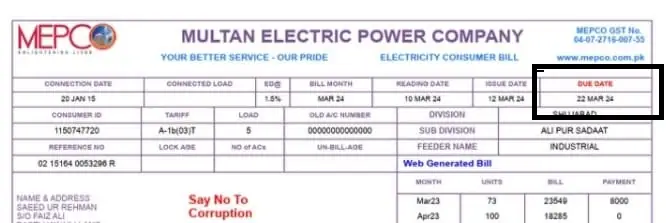
Many consumers find it helpful to note this date in their phone calendar or set a reminder as soon as the bill is generated, so they are never caught off guard.
One thing worth knowing is this is not always the same number every month. It can shift slightly depending on when the billing cycle falls and when the bill was generated. So even if you paid on the 12th last month and everything was fine, do not assume the 12th is always your deadline — check each bill individually.
If you check your bill online using your 14-digit reference number on our Mepco Bill Online page, the due date is displayed on the digital bill in exactly the same position.
What Happens If You Miss the Due Date?
Missing it sets off a chain of events that gets progressively more inconvenient the longer you wait. Here is exactly what happens:
Late Payment Surcharge Is Added
A Late Payment Surcharge (LPS) may be added when an electricity bill is paid after the due date. The amount depends on the applicable tariff, billing rules and consumer category.
Check the amount shown on your bill rather than assuming that a fixed percentage applies to every consumer.
This is not a manual process — it is calculated automatically by the MEPCO billing system. You cannot negotiate it away or ask for it to be removed simply because you forgot. The only way to avoid it is to pay before the due date.
Grace Period — What It Is and What It Is Not
Payment after the due date may be possible, but consumers should not assume that a fixed grace period applies to every bill or connection.
Check the payment status and applicable charges on your latest bill. If you are concerned about disconnection, contact MEPCO promptly rather than relying on an assumed grace period.
The due date and any applicable late-payment period should be checked against the information on the current bill and the applicable MEPCO rules.
Disconnection Notice
If an electricity bill remains unpaid, MEPCO may take further action under the applicable consumer-service and disconnection procedures. Consumers who receive a disconnection notice should review the outstanding amount and contact MEPCO if they need clarification.
Electricity Disconnection
If the supply is disconnected because of an unpaid bill, the consumer may need to clear the outstanding amount and meet the applicable requirements for reconnection.
The exact process and charges should be confirmed with MEPCO at the time of reconnection.
What Is Late Payment Surcharge?
The Late Payment Surcharge on a MEPCO bill is a charge that may apply when payment is made after the due date.
The amount can depend on the applicable tariff, consumer category and billing rules. Check your latest bill for the exact amount charged.
If a bill remains unpaid, the outstanding balance can continue to affect later billing records. Consumers should check their latest bill and settle outstanding amounts as soon as possible.
The surcharge is shown as a separate line item on your next bill so you can see exactly how much extra you have been charged for the late payment.
Learn all online and offline MEPCO bill payment methods .
Can You Get an Extension on the MEPCO Bill Due Date?
If you cannot pay your bill by the due date, contact the relevant MEPCO office and ask whether a payment extension or other relief is available for your connection.
Any extension depends on the applicable consumer-service rules and the authority handling the request.
For official information about due date policies and consumer services, you can also visit the official MEPCO website at mepco.com.pk.
How to Never Miss the MEPCO Bill Due Date Again
The good news is that missing a due date is almost entirely preventable with a few simple habits:
Check your bill as soon as it is generated rather than waiting for it to arrive physically. You can view your complete MEPCO bill online using your 14-digit reference number the moment it is issued. This tells you the due date immediately.
Set a phone reminder a few days before the due date. This gives you time to arrange payment and avoid missing the deadline.
Save your MEPCO reference number somewhere easily accessible — in your phone contacts, a notes app, or even written on a sticky note near your meter. Having it ready means you can pay in under two minutes using internet banking or a mobile wallet whenever you see the reminder.
If you travel frequently or have irregular income, consider paying your bill as soon as it arrives rather than waiting for the due date to approach. There is no penalty for paying early.
View MEPCO helpline numbers and complaint support.
What If Your Bill Has an Error and the Due Date Is Approaching?
This is a situation that genuinely causes stress for a lot of consumers. Your bill arrives, something looks wrong — the units are too high, there is an unexpected charge, or the reading does not match your meter — but the due date is just around the corner.
If you believe your bill contains an error and the due date is approaching, contact MEPCO as soon as possible and ask how the disputed amount should be handled while the complaint is being reviewed.
Keep your bill, meter reading, previous bills and complaint record for reference. Ask MEPCO how the disputed amount should be handled while the complaint is being reviewed.
If you believe your entire bill is incorrect, visit your MEPCO subdivision office as quickly as possible and explain the situation. In some cases, they can flag the account while the complaint is under review.
If your meter is faulty and causing incorrect readings, read our complete MEPCO meter replacement guide to get it fixed before your next bill arrives.
Before paying your bill, calculate your estimated electricity cost with the MEPCO bill calculator.
Frequently Asked Questions (FAQs)
Q1. Is there a grace period after the MEPCO bill due date?
Payment after the due date may be possible, but consumers should not assume that a fixed grace period applies to every connection. Check the latest bill and applicable MEPCO instructions for the payment status and any charges.
Q2. Can I pay my MEPCO bill after the due date?
Yes, a bill may still be payable after the due date. However, applicable late-payment charges may be added. Check the latest bill for the exact amount payable.
Q3. Is the late payment surcharge the same for everyone?
The amount can vary according to the applicable tariff, billing rules and consumer category. The latest MEPCO bill should be used to confirm the amount charged.
Q4. What happens if I do not pay my MEPCO bill for several months?
If a bill remains unpaid, the outstanding amount may carry forward and applicable charges may be added. Further action, including disconnection, can follow under the applicable MEPCO procedures.
Q5. How can I check my MEPCO bill due date online?
Enter your 14-digit reference number on the MEPCO bill checking page and your complete bill including the due date will be displayed on screen.
Q6. Can MEPCO extend my bill due date?
If you cannot pay by the due date, contact the relevant MEPCO office and ask whether an extension or other payment arrangement is available for your connection. Any extension is subject to the applicable rules and approval process.
If your electricity bill shows extra charges or incorrect meter readings, you can follow our complete MEPCO bill correction guide to resolve the issue.
Conclusion
Keeping track of your MEPCO bill due date can help you avoid applicable late-payment charges and keep your account up to date.
If you miss the due date, check your latest bill for any applicable late-payment charge before making payment.
Check your bill when it is issued, note the due date, pay through an available payment channel, and keep your payment record.