
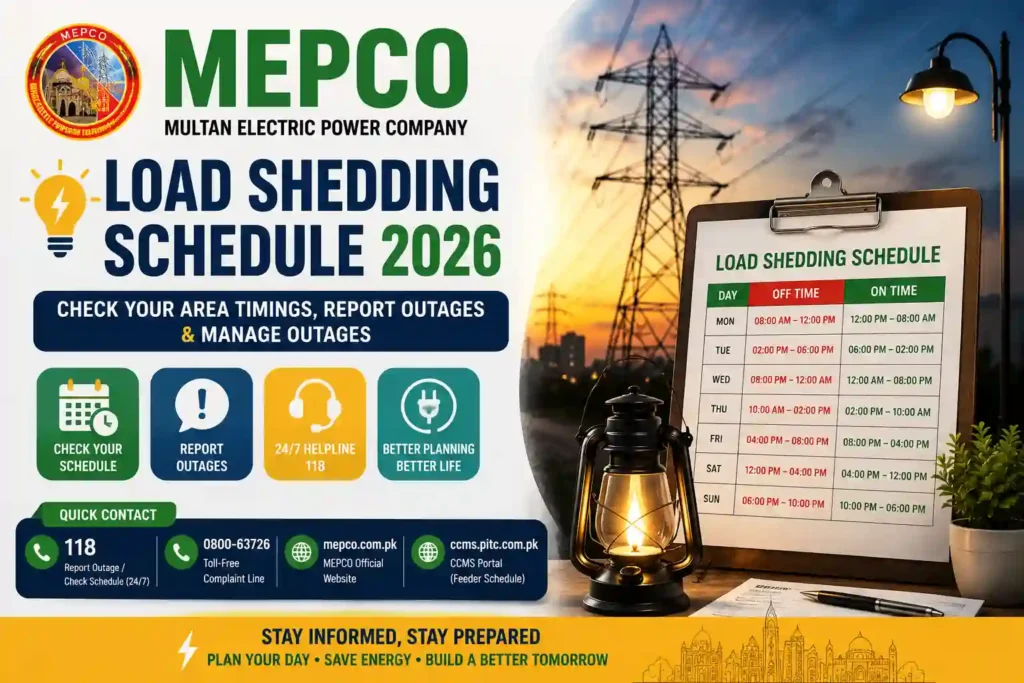
MEPCO Load Shedding Schedule 2026
MEPCO Load Shedding Schedule 2026
How to Check Your Area Timings, Report Outages & Manage Outages
If your electricity connection is supplied by MEPCO, you may sometimes need to know when power is expected to be unavailable in your area.
Load shedding schedules can vary between feeders, so a timetable for one area may not apply to another. The most useful approach is to check the schedule available for your own electricity connection before relying on a schedule shared on social media or in local groups.
This guide explains how to check the available schedule, how to report an outage, and what to do if the power goes out outside the expected time.
| MEPCO Load Shedding — Quick Information Complaint / Outage Helpline 118 Toll-Free Customer Support 0800-63726 Online Complaint System CCMS (PITC) Reference Number 14 digits |
What Is MEPCO Load Shedding?
Load shedding means a temporary interruption of electricity supply in an area according to a planned schedule.
The reasons for an outage can vary. They may include limits on available electricity supply, maintenance work, faults, feeder conditions or other operational requirements.
It is also important to remember that a planned outage and an unexpected fault are not always the same thing. A feeder fault, damaged line or transformer problem can cause an outage even when no load shedding is scheduled.
Why Can Load Shedding Times Differ Between Areas?
A load shedding schedule may differ between feeders. A feeder supplies electricity to a particular group of consumers, so two nearby areas may not always have the same outage timings.
For this reason, a schedule shared for a whole city may not match the timings for every consumer.
If you receive a schedule from a WhatsApp group, Facebook page or another local source, check it against the latest information available for your own connection before relying on it.
How to Check Your MEPCO Load Shedding Schedule
The Power Information Technology Company (PITC) provides online electricity services, including a Load Shedding Schedule service for electricity consumers.
For the latest information, you can also check the official PITC website and use the available load management services.
If schedule information is available for your connection, use your 14-digit Reference Number where requested. Always check the current information rather than relying on an old schedule saved on your phone or shared by someone else.
Step 1 — Find Your Reference Number
Take any recent MEPCO electricity bill and find your 14-digit Reference Number. It is normally printed in the upper section of the bill.
You can also use this Reference Number when checking your MEPCO bill online. Enter all 14 digits carefully because an incorrect number may prevent the system from finding the relevant information.
Step 2 — Open the CCMS Feeder Information Page
Open the CCMS feeder information page and enter your 14-digit Reference Number where requested.
If information is available for your connection, review the feeder and outage details shown by the system. The information displayed may change as schedules and operational conditions change.
Step 3 — If You Cannot Check the Schedule Online
If the online page is unavailable or you cannot find the information you need, contact MEPCO through its customer complaint or helpline channels.
Keep your 14-digit Reference Number ready and explain your area and the problem you are experiencing.
Planned vs Unplanned Outages — How to Tell the Difference
A planned outage is an interruption that appears as part of an available load shedding or maintenance schedule.
An unplanned outage can happen because of a feeder fault, transformer problem, damaged electricity line or another technical issue.
If your electricity goes off, first check whether an outage is shown for your area. If there is no scheduled outage, you can report the problem through the appropriate MEPCO complaint channel.
When reporting an outage, keep your Reference Number and area details ready.
How to Manage During Load Shedding
A few simple steps can make planned outages easier to manage:
If you notice repeated voltage problems or damage to electrical equipment, report the issue through the appropriate MEPCO complaint channel.
How to Report a Load Shedding Complaint
You can report an electricity problem when:
- Power is out when no outage is shown for your area.
- The outage continues longer than the available schedule indicates.
- You are experiencing a technical problem such as low voltage or repeated feeder faults.
When making a complaint, provide your 14-digit Reference Number, area name and a short description of the problem.
Keep the complaint number after submitting your complaint. It can be useful if you need to contact MEPCO again about the same issue.
For additional contact numbers, see our MEPCO Helpline Numbers guide.
Frequently Asked Questions — MEPCO Load Shedding Schedule
How can I check my MEPCO load shedding schedule?
Use the available CCMS feeder information facility and enter your 14-digit Reference Number. If schedule information is available for your connection, the relevant details will be shown.
Why is my load shedding time different from my neighbour’s?
Nearby properties can be supplied by different feeders. Because of this, their outage timings may not always be the same.
What should I do if the power goes out outside the expected time?
First check the available schedule for your connection. If there is no scheduled outage, report the problem through the appropriate MEPCO complaint channel.
Can I check the load shedding schedule by city?
A city-wide schedule may not apply to every consumer. Feeder-related information is more useful when you want to know the expected outage times for your own connection.
What number can I use to report an electricity outage?
You can use the applicable MEPCO complaint or helpline channel. Keep your 14-digit Reference Number ready when reporting the problem.
What is the difference between load shedding and a power fault?
Load shedding is a planned interruption. A power fault is an unexpected problem that can interrupt electricity because of equipment, feeder or line issues.
Can the load shedding schedule change?
Yes. Electricity schedules can change because of supply conditions, maintenance, faults or other operational requirements. Check the latest available information rather than relying on an old schedule.
Conclusion
MEPCO load shedding timings can vary between areas, so it is better to check the information available for your own connection instead of relying on a general city schedule.
Keep your 14-digit Reference Number handy when checking the available feeder information or reporting an outage.
If the power goes out unexpectedly, report the problem through the appropriate MEPCO complaint channel and keep the complaint number for your records.
Schedules and contact procedures can change, so check the latest information from MEPCO or PITC when you need current details.
Written by: Altaf | Updated: August 2026
Related: Peak Hours | Fuel Price Adjustment | Helpline Numbers | MEPCO Helpline | MEPCO Peak Hours |