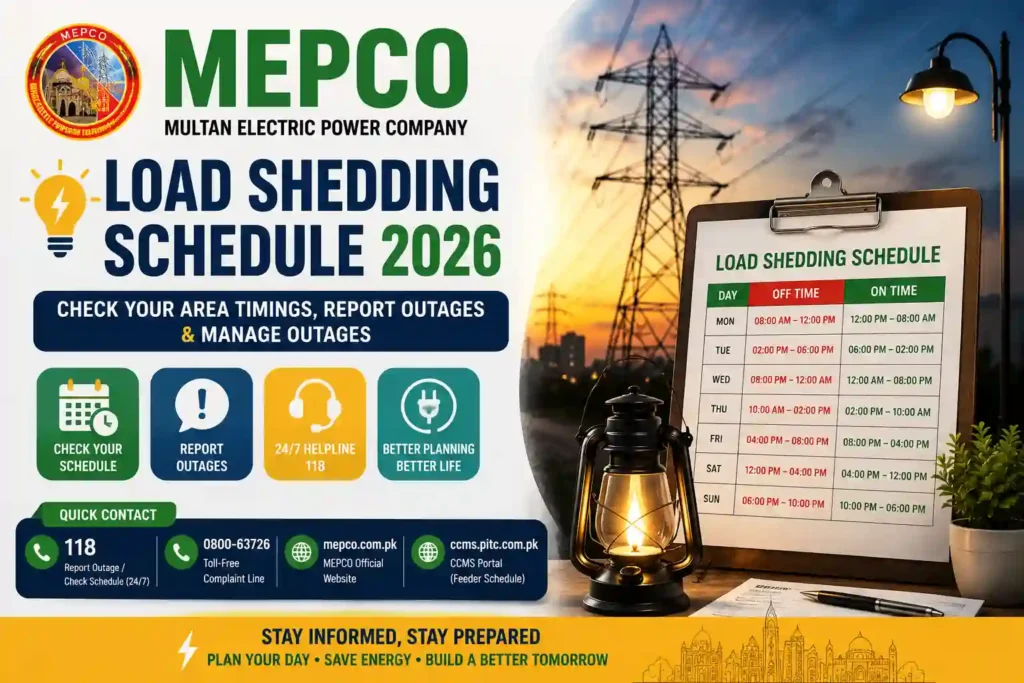
MEPCO Load Shedding Schedule 2026
How to Check Your Area Timings, Report Outages & Manage Outages
If you live anywhere in South Punjab and your electricity comes from MEPCO, load shedding is not an abstract concept — it is something you plan your entire day around. The question most people ask is simple: when exactly is the power going to go out today, and for how long? The honest answer is that no website can give you a single timetable that applies to everyone, because the MEPCO Load Shedding Schedule works differently from what most people expect. It is not set by city. It is not the same for every street in Multan or every neighbourhood in Bahawalpur.
It is set at the feeder level — meaning your specific timetable depends on which feeder serves your electricity meter, and that feeder has its own schedule completely independent of what your neighbour on a different feeder might experience. This guide explains how the system works, how to check your own timings, and what to do when something goes wrong.
| MEPCO Load Shedding — Quick Contact Numbers Report Outage / Check Schedule (24/7): 118 Toll-Free Complaint Line: 0800-63726 CCMS Portal (Feeder Schedule): ccms.pitc.com.pk/FeederDetails MEPCO Official Website: mepco.com.pk |
What Is MEPCO Load Shedding and Why Does It Happen?
Load shedding — officially called planned load management — is the deliberate, scheduled reduction of electricity supply to specific areas for a defined period. MEPCO implements the load shedding schedule when total electricity demand across South Punjab exceeds the available supply from the national grid. It is not a punishment and it is not random, even though it often feels that way. The grid has a fixed amount of electricity available at any given time, and when demand outstrips that supply, some areas have to be temporarily cut off so the rest of the system does not collapse entirely.
The first cause is a genuine supply-demand gap. Pakistan’s power generation capacity, while it has improved over the years, still falls short of peak demand during summer months when air conditioners are running across 13 districts simultaneously. A single spike in demand on a hot July afternoon in Multan can tip the entire South Punjab grid into deficit territory within minutes.
The second cause is seasonal. Before the monsoon arrives in July and August, dam levels fall and hydroelectric output drops significantly. Pakistan depends heavily on cheap hydro for its baseload, and when water levels are low, the grid compensates by firing up expensive thermal plants running on imported LNG and furnace oil. This creates both higher costs and tighter supply at the same time — which is exactly why summer load shedding and summer electricity bills tend to peak together.
The third cause is infrastructure. Line losses, transformer overloads, and feeder faults limit how much power can physically be delivered to certain areas even when supply is technically available at the grid station level. Older feeders with high loss percentages are more vulnerable to overloading, which sometimes causes unplanned outages on top of whatever is scheduled.

The Most Important Thing Most People Get Wrong
The biggest misconception about the MEPCO load shedding schedule is that there is a single published timetable for each city that applies to everyone in that city. There is not. Schedules are published and managed at the feeder level, not the city or district level. A feeder is the power line that runs from a grid station to a group of consumers in a specific area.
Two houses on opposite sides of the same street in Multan can be on completely different feeders and therefore have completely different load shedding schedules. This is not an edge case — it is the normal situation across the MEPCO network.
This is why WhatsApp messages with load shedding timetables that circulate in family groups and neighbourhood chats are almost always wrong for at least some of the people who receive them. Someone in the group whose feeder happens to match the schedule in the image will find it accurate, and everyone else will be confused when the power goes out at a different time. The only reliable way to know your specific MEPCO load shedding schedule is to check using your own reference number on the official CCMS portal — which pulls the schedule for the exact feeder that serves your meter.
How to Check Your MEPCO Load Shedding Schedule — Step by Step
The official source for feeder-specific load shedding schedules is the CCMS portal operated by PITC. This is the same system MEPCO uses internally, and it is the only place where you get accurate, feeder-specific information rather than a general city-wide estimate.
Step 1 — Get Your 14-Digit Reference Number
Find your reference number on any old MEPCO electricity bill — it is printed at the top-left section and consists of exactly 14 digits. It is the same number you use to check your MEPCO bill online, and it never changes for your connection. Any bill you have, no matter how old, has the correct number.
Step 2 — Visit the CCMS Portal
Open your browser and go to ccms.pitc.com.pk/FeederDetails. Enter your 14-digit reference number in the search field and click the search button. The system identifies your feeder and displays the load shedding schedule assigned to it — typically showing the time windows when power will be cut, listed by day and hour.
Step 3 — If the Portal Is Inaccessible
Call 118 from any mobile network and ask the operator for your feeder’s current load shedding schedule. They have direct access to the same CCMS database and can read the information out to you. This works even during load shedding when your internet is down — mobile networks usually stay up independently of grid power.
Other Methods
The MEPCO official website at mepco.com.pk has a Load Shedding section with a search tool that queries the same database. The MEPCO Smart App on Android, available from the Google Play Store, also shows schedule information for registered connections alongside bill check and complaint features. Either method works with the same 14-digit reference number.
Why Some Areas Get More Load Shedding Than Others
Not all feeders in the MEPCO network receive the same amount of load shedding, and this is where the system feels genuinely unfair to a lot of honest consumers. NEPRA’s differential load shedding policy divides feeders into categories based on two factors: the feeder’s loss percentage and the bill payment recovery rate in that area.
Low-Loss Feeders
A feeder where most consumers pay their bills on time and where there are few illegal connections or theft incidents — called kunda connections locally — is classified as low-loss. Low-loss feeders receive significantly less load shedding, sometimes as little as two to four hours per day during peak summer, and minimal or zero outages during winter months.
High-Loss Feeders
A feeder where many consumers have illegal connections, where bills are frequently unpaid, or where the distribution infrastructure itself is old and leaking power is classified as high-loss. High-loss feeders can receive eight to twelve hours of daily load shedding during summer, and in some rural areas of DG Khan, Rajanpur, and Muzaffargarh the figure can be even higher.
The frustration for consumers on high-loss feeders who do pay their bills and have no illegal connections is entirely legitimate — they are experiencing the consequences of their neighbours’ behaviour with limited individual recourse. The system is designed as a collective incentive: when enough consumers on a feeder switch to legal connections and regular bill payment, the feeder’s category improves and scheduled outage hours reduce. This does happen in practice, but it takes sustained community compliance over time.
If your area is experiencing what feels like excessive load shedding compared to nearby streets, call 118 and ask which feeder category your area falls into. MEPCO is required to provide this information, and knowing your feeder’s classification helps you understand what to expect and whether your current schedule matches what has been officially notified.
Planned vs Unplanned Outages — How to Tell the Difference
This distinction matters practically because your response to each type should be different. A planned outage is part of the official MEPCO load shedding schedule — it is notified in advance, falls within the window on the CCMS portal, and will end at the scheduled time. An unplanned outage is a transformer fault, a feeder tripping due to overload, a line break from a vehicle accident or tree fall, or a technical fault at the grid station.
Unplanned outages are not on any schedule, have no predictable end time, and require a different response. The most reliable way to tell the difference is to check the CCMS portal with your reference number during an outage. If your feeder has a scheduled window covering the current time, the outage is planned and will likely end at the notified time. If the CCMS shows no scheduled outage for your feeder right now, the outage is unplanned and you should call 118 immediately to report it as a fault.
When you call, give your 14-digit reference number, your area name, and a brief description if you know what happened. MEPCO logs the complaint and dispatches a technical team. Unplanned outages that are formally reported via 118 are resolved faster than those that are not, because MEPCO prioritises repair dispatch based on the number of complaints logged for a given feeder fault location.
MEPCO is also required under NEPRA regulations to announce any changes to the planned load shedding schedule at least 24 hours in advance during summer peak months. If your schedule changes without notice and the outage is significantly longer than usual, that is grounds for a complaint both to MEPCO at 118 and, if unresolved, to NEPRA at their consumer helpline 080025622.
MEPCO Load Shedding by Circle — General Patterns in 2026
While exact timings vary by feeder, there are observable patterns across MEPCO’s different circles based on infrastructure quality, population density, and feeder loss categories. These are general patterns — not official MEPCO notifications — and your actual schedule may differ based on your specific feeder. Always verify through the CCMS portal.
| Circle | Urban Feeders | Rural / High-Loss Feeders |
| Multan | 4 – 6 hours/day | 8 – 10 hours/day (Shujabad, Jalalpur Pirwala areas) |
| Bahawalpur | 4 – 7 hours/day | 8 – 12 hours/day (Hasilpur, Mandi Yazman, Cholistan belt) |
| DG Khan | 6 – 8 hours/day | 10 – 14+ hours/day (Taunsa, Rajanpur, Koh-e-Suleman) |
| Sahiwal | 4 – 6 hours/day | 6 – 10 hours/day (Pakpattan, Chichawatni rural areas) |
| RYK | 6 – 8 hours/day | 8 – 14 hours/day (rural RYK, Sadiqabad, Liaqatpur) |
How the MEPCO Load Shedding Schedule Affects Your Electricity Bill
Most people do not realise that load shedding and your monthly electricity bill are connected in two ways that work against you simultaneously during summer. The first is obvious — you consume more units when it is 47°C and your AC runs for sixteen hours. The second is far less obvious but equally significant.
When dam levels drop before the monsoon and hydro output falls, the national grid compensates by running expensive thermal plants on imported LNG and furnace oil. The cost difference between cheap hydro electricity and expensive thermal electricity is passed directly to consumers through the Fuel Price Adjustment charge on your bill. This means your per-unit cost goes up even in months where your consumption does not change — so you end up paying more per unit AND consuming more units at the same time.
This is why bills during the months when load shedding is worst also tend to carry the highest FPA charges. Our Fuel Price Adjustment guide explains exactly how FPA is calculated each month and what drove the significant increases seen in early 2026. And our MEPCO Peak Hours guide explains how shifting heavy appliance usage to off-peak hours can meaningfully reduce your monthly bill even during the worst load shedding months.
How to Manage Load Shedding and Protect Your Household
The advice that actually works for managing load shedding in South Punjab is not the standard list of turning off a few lights. The challenge here is managing heat, protecting appliances, and keeping essential functions running during outages that can stretch for several hours at a time in the peak of summer.
UPS — The Most Common Solution
A UPS with a quality battery handles fans, LED lights, and phone charging without any issues during outages. Most South Punjab households already have one. The limitation is that a standard UPS cannot run an air conditioner, which in a DG Khan or RYK summer is a significant gap. If you need AC coverage during outages, an inverter AC paired with a larger inverter system is the practical upgrade — inverter compressors draw considerably less power and can run on home inverter setups that standard ACs cannot.
Solar With Battery Backup
Solar with battery backup is the most complete solution for households that experience eight or more hours of daily load shedding. A properly sized rooftop system runs essential loads throughout the day and recharges during sunlight hours regardless of what the MEPCO load shedding schedule shows. Before investing, read our MEPCO Net Metering Policy guide and the NEPRA Solar Licence guide — the rules were significantly updated in 2026 and the economics of solar with net billing have changed from previous years.
Appliance Protection
The most important habit during load shedding is to unplug sensitive electronics — televisions, computers, refrigerators — before the power comes back on. The voltage spike when electricity is restored after an outage is one of the most common causes of appliance damage across South Punjab, and a single incident can cost considerably more than a voltage stabiliser would have. If you have been experiencing repeated appliance damage from voltage fluctuations on your feeder, this is a formal complaint matter — our MEPCO Bill Correction guide covers how to document and file such complaints properly.
If your bill is showing units that seem high given the actual hours of supply you have been receiving, check your meter reading and compare it to your MEPCO bill online. Our MEPCO Helpline Numbers page has all division-level contact numbers by city if you need to reach your local office directly.
Load Shedding and the 200-Unit Protected Consumer Threshold
This is a detail that catches many households off guard during summer. If your household normally stays below 200 units per month and enjoys the Protected consumer tariff — which carries significantly subsidized per-unit rates — summer load shedding can work against you in an unexpected way. When outages reduce your available supply hours, many households compensate by running appliances more intensively during the hours power is available, which pushes monthly consumption above 200 units and triggers reclassification as a Non-Protected consumer with much higher per-unit rates.
The Cross Subsidy Program 2026 provides additional relief for Protected consumers who maintain consistent low consumption. If your average is close to the 200-unit threshold, use the MEPCO Bill Calculator to model different consumption scenarios before they show up on your actual bill.
When and How to File a Load Shedding Complaint
A load shedding complaint is worth filing in three specific situations: when your area is experiencing outages longer than the officially scheduled window for your feeder; when outages are happening entirely outside scheduled hours without prior notification; or when you are experiencing voltage fluctuations and low voltage that is damaging appliances, which is a separate technical issue from scheduled load shedding but handled through the same complaint channel.
Call 118 from any mobile network, give your 14-digit reference number, your area name, and a description of the problem. Write down the complaint number you receive — you will need it for any follow-up. If the issue is not resolved within the timeframe the operator gives you, call back with the complaint number and ask to escalate it to the divisional level.
If repeated calls to 118 do not resolve a systematic overloading or schedule violation issue in your area, the next step is NEPRA’s consumer complaint portal at ccms.pitc.com.pk or their helpline 080025622. MEPCO circles respond considerably faster once a complaint has been formally logged with the regulator. For all local office and helpline numbers by district, visit our MEPCO Helpline Numbers page.
Frequently Asked Questions — MEPCO Load Shedding Schedule
Q: How do I find my exact MEPCO load shedding schedule?
Go to ccms.pitc.com.pk/FeederDetails and enter your 14-digit reference number. The portal shows the schedule for your specific feeder. If the portal is inaccessible, call 118 and ask the operator. These are the only reliable sources — city-wide timetables shared on social media or WhatsApp are almost never accurate for every consumer.
Q: Why is my neighbour’s load shedding different from mine?
Because you are most likely on different feeders. The MEPCO load shedding schedule is set at the feeder level, not by street or neighbourhood. Two properties next to each other can be on completely different feeders with completely different schedules. The only accurate way to know your own schedule is to check with your specific reference number.
Q: Why does my area get more load shedding than others?
NEPRA’s differential load shedding policy assigns longer outage hours to feeders with higher loss percentages — areas with more illegal connections, lower bill payment rates, or older infrastructure with more power leakage. Better-performing areas with lower losses get shorter scheduled outage windows. If you believe your area’s load shedding is excessive relative to its actual payment compliance, call 118 to raise a formal complaint.
Q: What should I do if power goes out outside the scheduled window?
Check the CCMS portal first to confirm whether your feeder has a scheduled outage at that time. If it does not, the outage is unplanned — likely a feeder fault or transformer issue. Call 118 with your reference number to report it immediately. Reporting matters because MEPCO prioritises repair dispatch based on the number of complaints logged for a given fault location.
Q: Does load shedding affect my electricity bill?
Not directly in terms of units — you are only billed for units your meter records as consumed. However, load shedding correlates with periods of high thermal generation, which drives up the Fuel Price Adjustment charge on your bill. Read our Fuel Price Adjustment guide to understand how this works in detail.
Q: Can solar eliminate load shedding from my life?
A properly designed solar system with battery backup can power essential loads throughout the day regardless of the MEPCO load shedding schedule. However, the economics changed significantly with the 2026 NEPRA net billing update. Read our MEPCO Net Metering guide before investing to understand the current compensation rates and what system size makes financial sense for your consumption level.
Q: What is the MEPCO load shedding helpline number?
Call 118 from any Pakistani mobile network — available 24 hours a day for outage reports, complaint registration, and schedule queries. The toll-free number 0800-63726 is free from landlines. For all MEPCO division-level contact numbers by city, visit our MEPCO Helpline Numbers page.
Q: How do I report excessive or unscheduled load shedding?
Call 118, log a formal complaint with your reference number and area details, and note the complaint number. If the issue persists after the stated resolution timeframe, escalate to NEPRA at 080025622 or through their online portal. Visiting your MEPCO subdivision office in person with a written complaint is also effective for recurring issues that phone calls have not resolved.
A Final Word on the MEPCO Load Shedding Schedule
Load shedding is a reality that millions of households in South Punjab navigate every day, and the frustration it causes is entirely legitimate. What this guide gives you is the information to navigate it more effectively — knowing exactly how to check your feeder’s schedule, understanding why your area gets the hours it does, being able to tell an unplanned fault from a scheduled outage, and knowing the right steps when something outside the schedule happens. The CCMS portal at ccms.pitc.com.pk/FeederDetails and the helpline at 118 are your two most useful tools. And for everything else related to your MEPCO electricity connection — your monthly bill, payment options, and consumer guides — visit the MEPCO bill check tool on our homepage.
Written by: Altaf | Updated: August 2026
Related: Peak Hours | Fuel Price Adjustment | Helpline Numbers | Bill Correction | Net Metering 2026