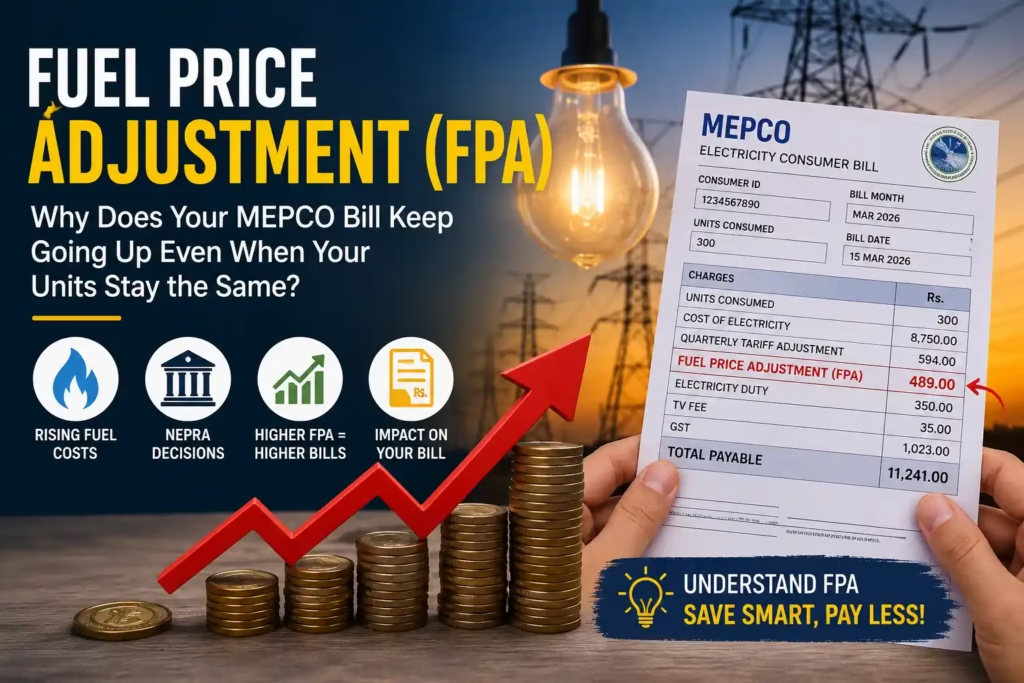
Fuel Price Adjustment
Fuel Price Adjustment – Why Does Your MEPCO Bill Keep Going Up Even When Your Units Stay the Same?
You checked your meter. You did not buy a new appliance. Your AC ran the same number of hours. But your electricity bill is higher than last month. This happens to thousands of MEPCO consumers every single month — and most people have no idea why.
The answer is not a billing error. It is not MEPCO overcharging you. It is a charge called Fuel Price Adjustment (FPA). Once you understand how it works, you will never be confused by a high electricity bill again.
In this guide, I have explained everything in plain English — what FPA is, how it is calculated, the real numbers from 2026, and what you can actually do to lower its impact on your monthly bill.

What is Fuel Price Adjustment (FPA) in a MEPCO Bill?
Most of Pakistan’s electricity comes from power plants that burn fuel — furnace oil, natural gas, diesel, and imported LNG. The cost of running these plants changes every month depending on global fuel prices.
At the start of the year, NEPRA sets an electricity tariff based on an estimated fuel cost. But actual fuel costs do not always match that estimate. When fuel turns out to be more expensive than expected, someone has to pay the difference. That someone is you — through the Fuel Price Adjustment charge on your bill.
If fuel happens to be cheaper than expected in a given month, you actually get a small reduction. That is called a negative FPA. But if you have been getting your MEPCO bill for any length of time, you already know that the negative ones are rare.
FPA shows up on your bill as a separate line — usually labelled “Fuel Price Adj” or “FPA” or “Fuel Charges Adj.” It is decided by NEPRA every month through an official process, and MEPCO has no choice but to apply it to your bill.
How is the Fuel Price Adjustment Actually Calculated?
The math is straightforward. NEPRA announces an FPA rate in rupees per unit. That rate gets multiplied by however many units you consumed that month. The more units you use, the bigger your Fuel Price Adjustment charge.
FPA Charge = Rate × Your Units Consumed
Here is what this looked like in real terms when NEPRA approved Rs. 1.63 per unit for January 2026:
| Units Consumed | FPA Rate | Extra Amount Added to Your Bill |
|---|---|---|
| 200 units | Rs. 1.63 | Rs. 326 |
| 300 units | Rs. 1.63 | Rs. 489 |
| 500 units | Rs. 1.63 | Rs. 815 |
| 700 units | Rs. 1.63 | Rs. 1,141 |
Think about that for a second. A household using 300 units in March 2026 paid Rs. 489 extra — from FPA alone — without using a single extra unit. That is not a small number for most families. And it happens every month, at a different rate.
What Actually Happened in 2026 — Real Fuel Price Adjustment Numbers
This is not theory. Here is what NEPRA actually decided in the first few months of 2026, based on official public hearings and notifications. Each month the Fuel Price Adjustment was different — sometimes painful, once even a small relief:
| Bill Month | FPA Rate Approved | What It Meant for Consumers |
|---|---|---|
| February 2026 | +Rs. 0.48 per unit | Small increase for MEPCO and LESCO consumers |
| March 2026 | +Rs. 1.63 FCA + QTA = Rs. 1.98 total | Rs. 23 billion extra burden nationally — Rs. 489 extra on a 300-unit bill |
| April 2026 | +Rs. 1.42 per unit | Another increase across all ex-WAPDA DISCOs including MEPCO |
| May 2026 | Negative (small relief) | A small credit appeared on bills — rare but welcome |
March 2026 was particularly rough. The combined FCA and QTA hit consumers with Rs. 1.98 per unit extra — and across Pakistan’s roughly 30 million registered consumers, that added up to a Rs. 14 billion burden in a single billing cycle. NEPRA acknowledged that figure in its own official determination.
Who Decides the FPA — And How?
A lot of people assume MEPCO is just hiking bills whenever it feels like it. That is not how it works. There is a proper regulatory process behind every FPA decision:
- CPPA-G submits a petition: The Central Power Purchasing Agency (CPPA-G) buys electricity on behalf of all distribution companies including MEPCO. Every month it submits actual fuel cost data to NEPRA.
- NEPRA holds a public hearing: Before any decision is made, NEPRA announces and holds an open public hearing. Consumers and industry stakeholders can attend and raise objections.
- NEPRA issues a formal determination: After the hearing, NEPRA publishes an official notification with the approved FPA rate. Consumers can also review official Fuel Charges Adjustment decisions through the latest NEPRA notifications before filing a billing complaint.
- DISCOs apply it to bills: MEPCO and other distribution companies apply the approved rate to consumer bills for that billing period.
To give you a sense of the numbers involved — in January 2026, Pakistan generated 9,140 GWh of electricity at a total fuel cost of Rs. 106 billion, working out to Rs. 11.64 per unit at the generation level. After transmission losses, the delivered cost to DISCOs rose to Rs. 12.18 per unit. Since this was above the reference price built into the tariff, the difference became a positive FPA charged to consumers.
Which Fuels Drive Your Bill Up — And Which Keep It Down
Not all electricity costs the same to generate. The fuel mix used in any given month directly determines whether your FPA goes up or down:
| Fuel Source | Cost Level | Effect on Your Bill |
|---|---|---|
| Hydropower (dams) | Very cheap | Keeps FPA low or negative |
| Local natural gas | Moderate | Moderate FPA increase |
| LNG (imported gas) | Expensive | Pushes FPA higher |
| Furnace oil | Expensive | Significant FPA increase |
| Local coal | Moderate | Moderate impact |
| Imported coal | Expensive | Higher FPA increase |
| Diesel | Very expensive | Highest FPA — only used in emergencies |
The problem in summer is that dam levels drop before the monsoon rains arrive. Pakistan relies heavily on hydro in normal months, but when water levels fall, the grid has to compensate by running expensive thermal plants on furnace oil and imported LNG. That is why FPA rates tend to spike in summer — and why your bills get hit from two sides at once.
FPA, FCA, QTA — Are These All Different Things?
If you have looked closely at your MEPCO bill, you may have spotted multiple adjustment charges and wondered what each one is. Here is a quick breakdown:
| Charge | How Often | What It Covers |
|---|---|---|
| FPA / FCA (same thing) | Every month | Difference between assumed and actual fuel cost for power generation |
| QTA (Quarterly Tariff Adjustment) | Every 3 months | Difference between assumed and actual distribution company costs |
| FC Surcharge (Financing Cost) | Every month | Power sector debt servicing — currently Rs. 3.2 per unit |
FPA and FCA are the same charge — just two different names used by different DISCOs and media outlets. You might see either label on your MEPCO bill. The March 2026 increase of Rs. 1.98 per unit was not all FPA — it was Rs. 1.63 from FCA and Rs. 0.35 from QTA, both hitting in the same billing cycle.
Who Does NOT Have to Pay FPA?
Not everyone gets hit by FPA. NEPRA has exempted certain consumer categories:
- Lifeline consumers — households using 50 units or less per month. Fully exempt from FPA.
- Protected consumers — households that have stayed below 200 units per month for six consecutive months. Also largely exempt.
- Electric vehicle charging stations — excluded from FPA to encourage EV adoption in Pakistan.
If you fall into one of these categories and are still seeing an FPA charge on your bill, that is worth checking. Call MEPCO helpline 118 or visit your subdivision office and ask them to review the bill.
How to Find the FPA Charge on Your MEPCO Bill
Once you know what to look for, it is easy to spot:
You can also check your full MEPCO bill online anytime using our free MEPCO Bill Check tool.
If the Fuel Price Adjustment amount appears unusually high or seems incorrect, read our MEPCO Bill Correction guide to learn how to file a complaint and request a review.
Why Are Summer Bills So Much Worse?
Consumers in Multan, Bahawalpur, Sahiwal, and DG Khan know the feeling — June, July, and August bills are on a completely different level compared to winter. There are actually two separate things working against you at the same time:
First — you consume more units. When it is 47°C outside, your AC, coolers, and fans run non-stop day and night. Your consumption genuinely goes up.
Second — the Fuel Price Adjustment goes up too. Before the monsoon, dam levels are lower and hydro output falls. The grid compensates by running expensive thermal plants on diesel and imported LNG. The FPA rate rises alongside your consumption. You end up paying more per unit AND consuming more units at the same time.
That is why a household paying Rs. 8,000 in January can easily receive a bill of Rs. 20,000 or more in July — with no new appliances and no unusual change in habits. Both forces are hitting simultaneously.
What Can You Actually Do About It?
You cannot control the FPA rate — NEPRA sets it based on global fuel markets. But since FPA is charged per unit, using fewer units directly reduces how much FPA you pay. Here is what actually works:
How Bad Has the Fuel Price Adjustment Actually Gotten? A Quick Historical View
Back in 2015, this charge was usually under Rs. 1 per unit — often much less. By 2026, it regularly sits between Rs. 1.42 and Rs. 1.98 per unit, sometimes higher. That is nearly double compared to a decade ago.
Multiply Rs. 1.63 by 300 units and you get Rs. 489 — from one line item on one bill, for one household. Multiply that by 30 million consumers across Pakistan and you reach the Rs. 14 billion that NEPRA acknowledged in its March 2026 determination. That is the real scale of what FPA does to Pakistani households every month.
Frequently Asked Questions
Q1: My units are the same but my bill is higher — is something wrong?
Most likely nothing is wrong with your meter. The FPA rate changes every single month. If it went up this month, your bill goes up too — regardless of your consumption. Check the FPA row on your bill to confirm. If you suspect your meter is faulty or recording incorrect readings, see our MEPCO Meter Replacement guide for the replacement process.
Q2: Is Fuel Price Adjustment the same as FCA?
Yes, completely. FPA and FCA (Fuel Charges Adjustment) are two names for the same charge. Different DISCOs and news outlets use both terms interchangeably.
Q3: Are there other adjustment charges besides FPA?
Yes. You may also see QTA (Quarterly Tariff Adjustment) every three months, and FC Surcharge every month at Rs. 3.2 per unit. In March 2026, FCA and QTA both appeared on the same bill, which is why that month’s increase felt so sharp.
Q4: I am a lifeline consumer — should I be paying FPA?
No. Lifeline consumers (up to 50 units/month) and protected consumers (under 200 units/month for six consecutive months) are exempt from FPA. If you see FPA on your bill and belong to either category, contact MEPCO helpline 118 to get it corrected.
Q5: Can NEPRA approve FPA without telling anyone?
No. NEPRA is legally required to hold a public hearing before approving any FPA. The hearing is announced in advance and is open to the public. You can even participate or submit written objections.
Q6: My bill shows a negative FPA — is that good?
Yes — it means actual fuel costs that month were lower than the tariff assumption, so NEPRA passed the savings on to consumers. This happened in May 2026. Your bill was slightly lower because of it.
Q7: Can I avoid FPA completely?
Two realistic ways: bring your consumption below 50 units per month (lifeline status), or install solar and reduce how many units you import from the MEPCO grid. FPA only applies to grid-imported units, not to solar power you generate and use yourself.
Q8: How do I check the exact FPA charged on my bill?
Check your bill online using our free MEPCO Online Bill Check tool. Look for the “Fuel Price Adj” row in the charges section to see your Fuel Price Adjustment amount.
Sources
- Government Energy Sector Reports
- NEPRA Fuel Cost Adjustment Determinations
- CPPA-G Monthly Fuel Cost Data
- MEPCO Consumer Information
The Bottom Line
Your electricity bill is not just about how many units you use. It is shaped every month by global fuel markets, Pakistan’s power generation mix, seasonal demand patterns, and NEPRA’s regulatory decisions. The Fuel Price Adjustment is the channel through which all of that reaches your bill — quietly, every month, whether you notice it or not.
Now that you know what it is and how it works, you are in a much better position. You know where to look on your bill, you know which months tend to hurt more, and you know the practical steps that can genuinely reduce your exposure to rising fuel costs.
For more helpful guides on MEPCO bill payment, meter replacement, new connections, load shedding schedules, and consumer rights — browse our other articles on this website.
To check your latest MEPCO electricity bill, use our free MEPCO Online Bill Check tool. Consumers who are planning home renovations or shifting their meter location can also read our MEPCO Meter Relocation guide.